


In this issue
The Main Idea — Jason Barnard’s whole method, in 30 seconds
How He Coins a Term — and the test he uses to kill his own bad ones
YOU×AI Spotlight — $79 tickets end September 1
Worth Your Time — Dorie Clark’s The Long Game
One Idea to Steal — The four-sentence audit
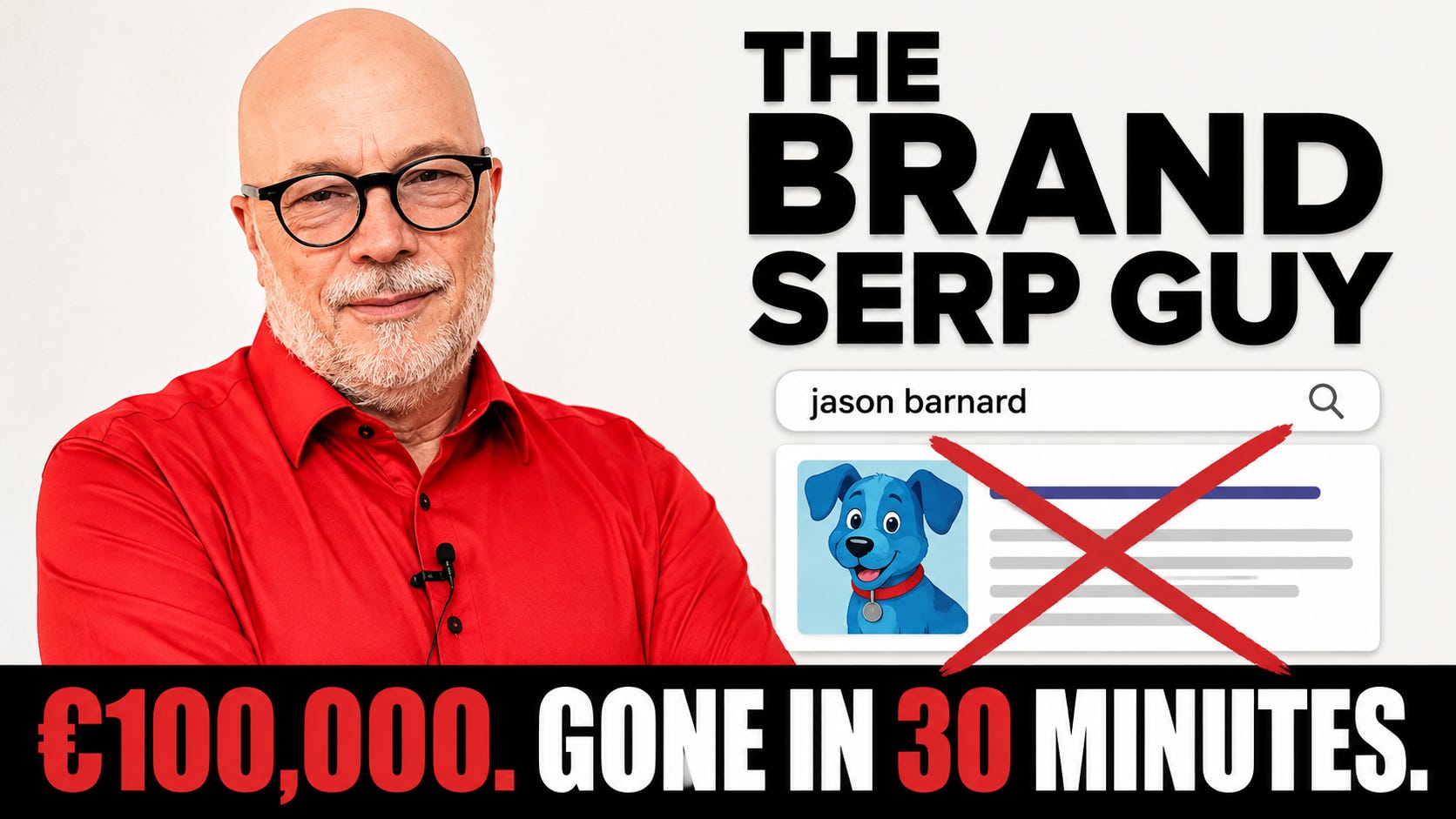
1. The Main Idea: A €100,000 Deal, Lost on a Train
Jason Barnard walked out of a meeting in Paris with a €100,000 deal all but signed.
Half an hour later, before his train got him home, the client emailed to cancel.
They had searched his name. Google told them he was a cartoon maker.
Google wasn’t wrong. Jason had spent years as the voice of Boowa the Blue Dog, a kids’ TV character on Playhouse Disney, with a website pulling a billion page views a year.
All of that lived in Wikipedia, IMDb, MusicBrainz - exactly the places Google and now ChatGPT go looking for facts.
The digital marketer lived nowhere.
The trip cost him €1,000. He lost the €100,000. So not only did he not make the money, the meeting cost him money.
And on the train home he started working on the problem that became Brand SERP, and then became Kalicube.
Here’s what I love about his story
Most of us are trying to get found at the top of the funnel. Jason flipped it.
He started at the very bottom, at the decision stage, where somebody has already met you and is now checking you out. As he put it to me, the top of the funnel has so many possible queries that you’re spitting in the ocean hoping to hit a whale.
At the bottom you know exactly what people are asking. They’re asking about you.
The method, in 30 seconds
Jason told me it used to take him ten minutes to explain. Then five. Then two. He’s got it down to 30 seconds now, and a friend once told him never to share his secrets. His answer: if I can explain it in 30 seconds, there isn’t much to keep secret.
So here it is, and it’s yours:
Build an entity home. A website in your name. yourname.com.
On the About page, say four things: who you are, what you do, who you serve, and why you’re credible.
Make everything you control say the same four things. LinkedIn, X, every profile, in any form. Corroborate that exact message.
Then go get third parties to say it too, with proof. Who you are, what you do, who you serve, why you’re credible - said by somebody other than you.
That’s the whole thing.
The rest is execution, and execution here means two words: clear first, then consistent. Consistent across the internet, and consistent across years. Not months. Years.
Why this works on the machines
Google is actively looking for an entity home. John Mueller has talked about it publicly - they want a source of reconciliation, a place where you give your version of the facts.
And it isn’t just Google. Jason has been collecting data since 2015, and he told me that the day ChatGPT launched, it said exactly the same thing about him and about Kalicube as Google did.
Same digital footprint. Same conclusion. A strategy he started in 2012 worked on a machine that didn’t exist yet, because they’re all reading the same web.
The part that should get your attention
With Google, somebody searched your name and looked at page one. That was your business card.
With AI, Jason says they go down what he calls the AI due diligence rabbit hole. The machine encourages them to keep researching you. It’s a much deeper narrative, and you don’t control any of it by default.
His line about the cost: even if the engines aren’t misrepresenting you the way they did him, they’re almost certainly underrepresenting you. That’s revenue leaking out of the bottom of your funnel from people who were ready to buy and never told you why they didn’t.
My favorite line in the whole interview came from one of his clients:
“I want to be able to sit in first class, chat with somebody, and never have to boast about anything I’ve ever done. Because when I get off the plane, I know they’re going to google me or ask ChatGPT. And ChatGPT and Google will do the boasting for me.”
That’s the goal. Not fame. Just having the machines say something at least as good about you as you’d say about yourself.
2. How He Coins a Term
This is the part I really wanted from him, because Jason is unusually good at it. Brand SERP is his. So is the funnel query pathway.
His trigger is simple: every time he runs into something he can’t describe without using six or seven words, he coins a term for it.
Then he does three things:
He writes the canonical definition on his own site first. The term, a comma, then five or six words defining it. Articles on his own property explaining what it is. His own site is the home of the meaning, the same way his entity home is the home of the facts about him.
He pushes it out and links it back. Articles elsewhere, podcasts, and - he says this explicitly - he asks podcast hosts to put his coined terms in the show notes, because that’s easier for the AI to digest. Wherever the term gets repeated, a link points home, so the machine can see that the mention over there means the same thing as the definition over here.
He gets other people to credit him with the coinage. He calls this temporal precedence. You need to be first, obviously. But you also need to demonstrate to the machines that you were first.
And here’s his bet, which I think is right:
He’s training the algorithms well enough that even when people use his terms without naming him, the AI names him anyway. The AI becomes the carrier of the ownership.
The test he uses to kill his own bad terms
He’s fallen into the trap of inventing too many, and terms people don’t understand. So now he applies what he calls the glossary test:
If you have to read a glossary to understand the term I just gave you, it’s not a good term.
He’s honest that some of his own don’t pass. “Entity home” is great if you’re a geek and you know what an entity is. It’s probably better as brand home or digital brand home. He’s retired some terms entirely, and he’s taking a lot of the coined language out of the book he’s writing from his 19-part Search Engine Land series, because he wants it accessible.
I told him about my own version of this. My friend Bryan Eisenberg - who with his brother Jeffrey coined “conversion rate optimization” - is the one who watched me interview founders, dig out the thing they take for granted, and said: that’s viral genius. That’s where the name came from.
And people still ask me if I’ll help them go viral on social media. So the glossary test is real, and I’m still working on mine.
One last thing he said, and it’s the whole game for a founder
I asked him: is it important to have a unique point of view, or is being really good at what you do enough?
His answer: yes to both, but you need the point of view.
AI already knows everything that’s been published. What it’s looking for is an information gap - something new. If you publish the same article as your competitor, that’s not interesting to a machine that already has your competitor’s article.
You don’t have to invent something completely new. You do have to have a different point of view. And if you have one, coin a term for it and teach the machines that the term means your definition.
That’s how you end up owning the perspective.
2. YOU×AI Spotlight — $79 tickets end September 1
The YOU×AI Summit is September 12 at the Performing Arts & Community Center, 924 Austin Ave, Waco. A full day on what AI actually changes about how you work.
Tickets are $79 until August 31. They go to $99 on September 1.
4. Worth Your Time: The Long Game by Dorie Clark
The Long Game: How to Be a Long-Term Thinker in a Short-Term World, Harvard Business Review Press, 2021.
Dorie Clark’s argument is that the things worth having - your career, your brand, the work you actually want to be known for - only get built over a horizon most of us never let ourselves look at.
What stands in the way is mental space.
We’re busy. We’re caught up in the minutia of every day. So we never sit still long enough to ask what we want to be true in ten years, or to work backward from it.
She wants you to make that space on purpose, and she treats it as the mechanism rather than a luxury.
Every one of us needs room to design the life we want to live over the long term. Almost none of us schedules it.
The audiobook is good, and so is the print version. I’ve done both.
She also references her earlier book, Stand Out, which I’d say is a precursor to what I’m doing with the Viral Genius Framework. Same instinct - find the idea that’s yours and build a following around it. The difference now is that you also have to be retrievable by a machine, under a term you own.
5. One Idea to Steal: The Four-Sentence Audit
Straight out of Jason’s method, and you can do it tonight.
Open your own About page and write down the four answers as they currently exist:
Who am I?
What do I do?
Who do I serve?
Why am I credible?
If you can’t find all four on that page, that’s your week’s work right there.
Then open your LinkedIn profile, your X bio, your company team page, and your last three podcast appearances. Ask the same four questions of each one.
You’re not looking for good writing. You’re looking for consistency. Four answers, said the same way, everywhere you control.
Then do the last one, which takes ten seconds and stings a little:
Ask ChatGPT “Who is [your name]?”
Whatever comes back is what your next buyer sees thirty minutes after they meet you.
Try the audit and hit reply with what ChatGPT said about you. I read every one.
Fernando Labastida