


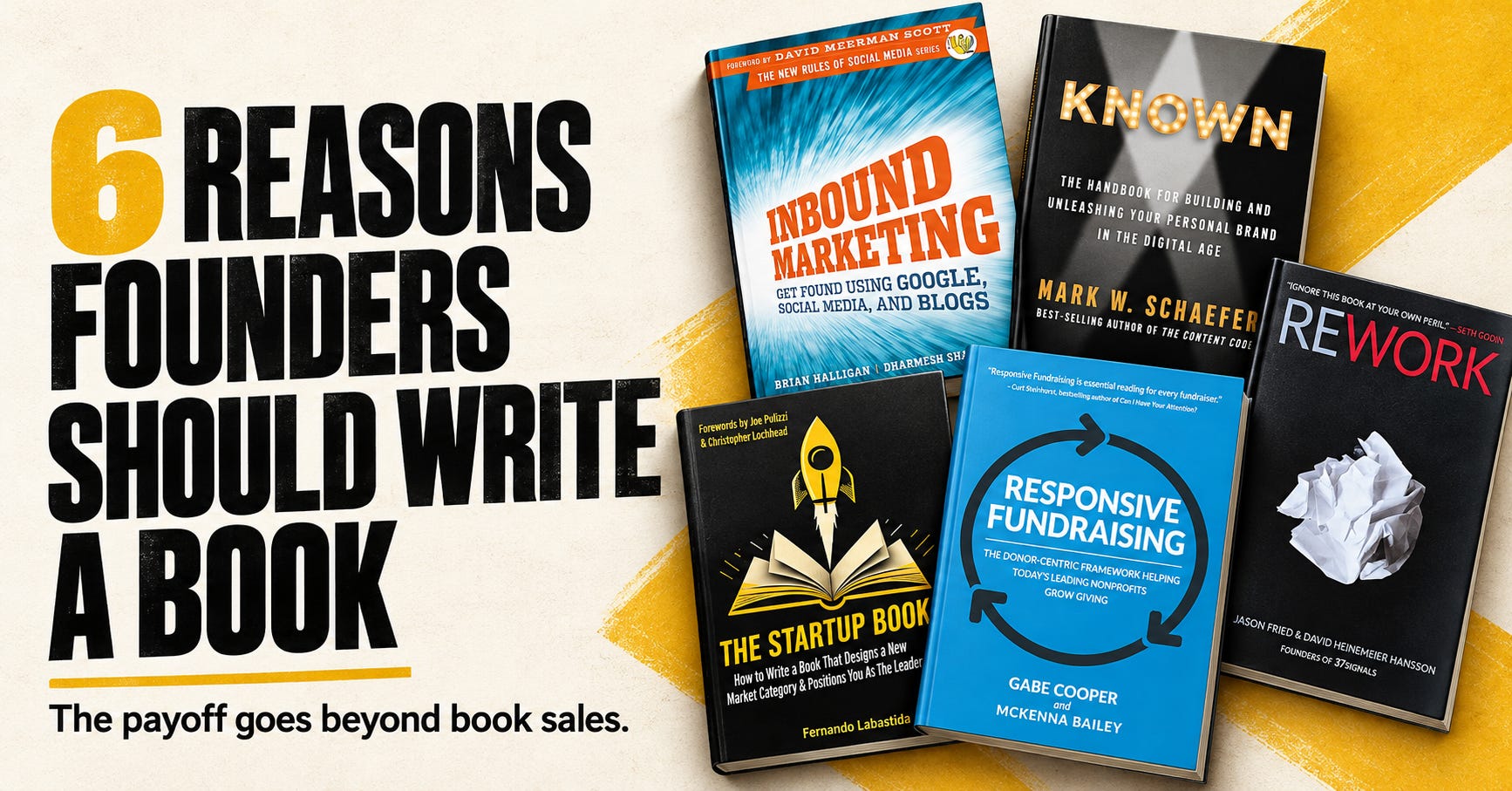
I always recommend to founders that they should write a book to position themselves and their companies as leaders within a new market space.
But I often get pushback: “I’d love to write a book, but what’s the benefit?”
I get it. Writing a book takes time, valuable time they could pour into growing their company.
And a lot of these founders don’t want the spotlight.
They don’t want to be influencers.
Some of them only keep a LinkedIn profile because they kind of have to.
So I sat down and made a list.
Here are the six reasons I give founders for writing a book:
Give your market a new perspective
Build your brand around one idea
Establish a category or framework tied to your name
Clarify your thinking so you can sell
Educate and attract the market you want to serve
Create opportunities beyond what you sell today
What’s missing from that list?
Book sales.
Marketing author Mark Schaefer, who has written several books, is blunt about it in his article “Is writing a book a marketing tactic or a long-term strategy?“:
“One of the main reasons people write books is to establish a source of passive income. This will not happen.“
Unless you’re Malcolm Gladwell or James Clear, the book won’t pay for itself in royalties.
It pays for itself in everything else.
Let’s go through the six.
1. Give your market a new perspective
Most of us get into business for one of two reasons.
We want to make money.
Or we saw a problem nobody was solving well, and from our perspective, the fix was obvious.
Usually it’s both.
But after a while, something else kicks in.
Remember Maslow’s hierarchy of needs? Food and shelter at the bottom, then safety, then all the way up to self-actualization at the top.
That’s where a lot of founders end up. We want to contribute something to the world.
And we start to notice that the problem we solve for our customers is a small version of a much bigger problem.
Say you build software for research labs. A narrow market. But the thing your software fixes shows up everywhere, and you can see it plain as day.
It’s like watching people stuck in traffic for an hour on the drive home, when all they want is to see their family and watch an episode of their favorite show.
If only they knew how to fix it!
That urge is a big reason to write a book.
Look at Jason Fried, co-founder of 37signals, the company behind the project management software Basecamp.
In 2010, he and his co-founder David Heinemeier Hansson published Rework.
Rework says very little about project management software. It’s about how to run a small company.
In an interview with the Book Overflow podcast, Fried said they “wrote this book to share our point of view on how a business should be and could be run.”
They saw small companies trying to run like big companies.
And they knew a better way, because they were living it.
You can do this even in an industry that hasn’t changed in decades. Accounting is accounting. Selling a house is selling a house. You still have to insure your car.
But if you figured something out that most people in your market haven’t, that’s a new perspective. And a book is how you share it.
2. Build your brand around one idea
In the same article, Schaefer points to his book Known, where the first stage of his four-step process is deciding what you want to be known for.
His line:
“A book can be a bold manifesto to help clarify your thinking and declare “this is me!”“
This is the heart of my upcoming book, Unopposed: Design a Personal Category Only You Can Own.
I call it your One Unforgettable Idea: the single idea a founder owns so completely that they stop being compared and become their own category.
The founder gets known for the idea. Then it cascades down to the company.
Think about Brian Halligan and Dharmesh Shah, the co-founders of HubSpot.
They’re known as the people who invented inbound marketing.
When HubSpot announced its $16 million Series C round, Halligan explained what made them different. Their vision was that “traditional, outbound marketing (telemarketing, email spamming, direct mail, etc.) is fundamentally broken.”
Then he wrote:
“Rather than automating and codifying the old rules of marketing, our vision is to transform marketing and then automate the new rules.“
And in the next sentence, he pointed to the book. Inbound Marketing: Get Found Using Google, Social Media, and Blogs came out the same day.
Look at that title.
“Inbound marketing” is the thing they wanted to be known for.
Before that book, there wasn’t a name for using Google, social media, and blogs to pull leads in.
Attraction instead of interruption.
Now it’s everywhere.
3. Establish a category or framework tied to your name
I have two favorite examples of this.
The first is Chris Ronzio, founder and CEO of Trainual.
You’ve probably heard of The E-Myth by Michael Gerber. Work on your business, not in it. Be the architect, and let your people do the work.
Great in theory.
But most founders never had a practical way to write down how their business runs, so they could step back and hand it off.
Ronzio built that way. He called it the Business Playbook.
He built Trainual, software where every process and standard operating procedure lives in one place, for every role in the company.
And he wrote the book: The Business Playbook.
The way I see it, The Business Playbook finishes the job Gerber started.
My second example is Gabe Cooper, founder and CEO of Virtuous, a CRM for nonprofits.
Think about the NPR or PBS fundraising drive. I love NPR and PBS, but golly, those drives get annoying.
Nonprofits give their biggest donors the VIP treatment. Lunches, visits, a real relationship.
Everyone else gets a mass email.
Cooper asked a different question: what if you treated every donor like you had a relationship with them?
With today’s software, and now AI, you can do that at scale.
He called it responsive fundraising, and he wrote the book, Responsive Fundraising, in 2020. In 2024, he followed it with The Responsive Nonprofit.
He talks about the approach in this Nonprofit Hub podcast episode.
And it just so happens his company sells the software to do it.
That’s the HubSpot play.
Sure, you can do inbound marketing by duct-taping WordPress, an email tool, Salesforce, and a social media tool together with Zapier.
Or you can use one inbound marketing platform: HubSpot.
Virtuous says the same thing about responsive fundraising.
The book names the category. The company owns it.
I wrote about this in The Startup Book in 2024, and I’m building on it in Unopposed.
4. Clarify your thinking so you can sell
I’ve been living this one for the last three weeks, working on Unopposed.
Have you heard the terms “planners” and “pantsers”?
A pantser writes by the seat of their pants. They start typing and figure it out later, which means round after round of edits.
A planner maps the whole book first.
I’m a planner. I build what I call a 3D outline: a book plan spreadsheet with every chapter on it, plus a detailed outline for each chapter.
That planning forces you to answer hard questions.
What’s my concept?
What’s my framework?
What are the pieces, and in what order?
Then when you write, you have to explain each piece. You do research. You interview people.
And the next day, on a sales call, you explain what you do better than you ever have.
All that hard thinking went into the book, and it comes out of your mouth.
5. Educate and attract the market you want to serve
If you’re bringing something new to market, you want buyers to show up already understanding it.
You shouldn’t have to explain everything from scratch on every sales call.
I know of companies that won’t take a meeting until the prospect has watched a certain video, or read a foundational blog post, or read the book.
A book also attracts your people.
Take my sister. She’s a realtor, and nothing like the realtor you’re picturing.
No pantsuits. No perfectly done hair. She’ll dye her hair dark red or purple. She has tattoos everywhere. She’s into yoga, meditation, and Day of the Dead art, and she’s active in breast cancer survivor groups.
She attracts musicians, artists, and coaches.
If she wrote a book, it wouldn’t need to invent a category. It would teach a way of living your life, and the people who share her lifestyle would find her.
Or take an accountant who grew up making decisions differently than everyone else.
With layoffs everywhere and AI taking over, more Gen Xers and Millennials are starting businesses because they have to.
Maybe that accountant’s way of making decisions, which they figured out 15 or 20 years ago, is now a survival tool.
Write that book, and the people who need it will choose that accountant to do their books.
6. Create opportunities beyond what you sell today
Salesforce sells CRM software.
It also runs Dreamforce, one of the biggest conferences in the world. They pretty much take over San Francisco every year, and the conference is a business of its own.
A book can do the same for you, on your own scale.
Paid speaking gigs.
Workshops.
Advisory work.
Board seats.
Training.
You might run a software company, a product company, or a services firm. A book that connects with your market opens revenue doors your core offer never could.
So, is it worth the time?
Go back to that list of six.
A new perspective. A brand built on one idea. A category with your name on it. A sharper sales pitch. A market that shows up educated. And revenue you didn’t know existed.
That’s a lot to get out of a few months of focused writing.
And you never have to become an influencer to get any of it.
The book does the talking.
Now I want to hear from you.
What’s a reason to write a book that I missed? Hit reply and tell me.
And if you’ve got a book in you and don’t know what it’s for, reply with “book.” That’s the first thing we figure out.
Know a founder sitting on a gold mine he isn’t exploiting? Send him this.