


I recently organized my first in-person conference in 15 years.
When I analyzed the source of actual ticket sales, social media came in at about 10%, but promotion via email newsletters accounted for more than 50% of sales.
Email is the best event promotion tool. Here’s why
When I was organizing the YouXAI Summit, I looked for any and all ways to drive ticket sales.
I got the speakers to promote it to their audience. I reached out to chambers of commerce. I reached out to newsletter owners.
When I looked at the tracking codes, the winner by far were the newsletters.
There wasn’t even a comparison.
Why is this? And why does social media suck when it comes to event promotion?
Email is the best promotion tool because subscribers choose to be subscribed
Due to CAN-SPAM rules, the EU ePrivacy directive, and just the nature of email marketing, if you’re subscribed to a newsletter, it’s because you chose to be subscribed.
But even before all the privacy laws, it’s just the nature of email marketing.
From his classic marketing book, “Permission Marketing,” the marketing book which set the stage for digital marketing as we know it today, Seth Godin talked about permission marketing as the antidote to interruption marketing.
The key quote from the book:
“Permission marketing is the privilege of delivering anticipated, personal and relevant messages to people who actually want them.”
Social media on the other hand is now no longer social media, if you didn’t already know that. It’s interest media.
That’s why you aren’t seeing all your friends’, cousins’, and neighbors’ posts anymore. You’re seeing posts that fall in line with your interests, tastes, and world view.
Social media is algorithmic and your connections are weak
That was a mouthful, wasn’t it?
GaryVee, back in 2024, said:
“We don’t even live in social media anymore. We now live in interest media. Doesn’t matter how many followers you have.
But what if your audience happens to see your event post? Probably a big “meh.” You see, your ties on social media are weak.
Mark Schaefer says, “In my classes, I explain that a social media audience represents ‘weak relational links.; What I mean by this is that a “like” or even a “follow” correlates to almost zero actual emotional connection to a brand or a business.”
What does that mean for you and your event promotion plan?
If your speakers or promotional partners say, “Hey, I’ll post about it three times on social media!”, tell them, “Em, can you actually send this to your newsletter subscribers instead?”
Only 5-6% of your social media audience will actually see your posts
After auditing 5,300 LinkedIn posts comparing impressions directly to total follower counts, the median organic reach was found to be 5.5%, according to The Shield Index.
“But how many of your newsletter subscribers will see your emails?” you might retort.
Glad you asked. Average email open rates vary between 29.81% and 40.04%, depending on the industry, according to MailChimp.
And email subscribers trust what they see in their newsletters far more than they trust what they on social media.
Here’s how to use email to fill your event
Ok this is all well and good, but how do you use email?
Here’s my quick and dirty four part guide for using email as a promotional strategy for your conference, meetup, summit or unconference.
1. Partner with a media partner that targets your niche or target audience
Notice the word “partner” there. I didn’t use that word casually.
Actually partner with somebody who will be your promotional partner.
My good friend Adria Munoz, a serial conference organizer (he organizes conferences across Latin America and Spain) told me that having a media partner is key to filling out his events.
And we’ve got to trust Adria, since he’s filling out events in Bogota, Santiago Chile, Mexico City, and Barcelona.
When I organized the AI Smart Summit, I partnered with CANACINTRA - Mexico’s national chamber of commerce for manufacturing companies.
Miguel Pirez, the Director of Events at CANACINTRA, said, “If we’re going to partner, we need you to put a large version of our logo on your event website.”
My client and I said, “Yes!” Why were we so easy to give away credit for organizing our 3-day virtual summit?
Because of CANACINTRA’s 52,000 manufacturing companies across Mexico.
And thanks to Miguel, CANACINTRA promoted the AI Smart Summit to the national email list, and the different email lists of every chapter, plus the WhatsApp groups for each chapter as well (more on groups like WhatsApp and Slack below).
For the YouXAI Summit in Waco, we partnered with The Waco Buzz, a three-times weekly newsletter that informs local Wacoans about events, restaurants, charities, and goings on around town.
I partnered with The Waco Buzz. The owner, Sam Harper, didn’t just copy and paste the templated event promotion text I gave him. He actively participated in helping write the copy.
2. Get the active participation of the founder / owner / leader
Whether you partner with a niche newsletter, a local newsletter, or an industry association that has your perfect audience, don’t just send them them a template for them to copy and paste.
Get the owner to actively participate in copywriting the ad for you.
And if you have a choice between just an image ad or a native ad, choose a native ad.
What’s a native ad?
A native ad is a newsletter article written in the same voice, tone and style of the regular newsletter articles, but you pay to have the newsletter operator write it.
This is an advantage for three reasons:
Newsletter subscribers are used to reading the newsletter in the voice, tone and style they receive everyday (or every week) in their inbox. A native ad does not interrupt that pattern, but blends with it.
Newsletter subscribers trust the recommendation of the newsletter, and by placing a native ad, the owner is putting her stamp of approval on your event.
Most of the time, the newsletter operator is a professional copywriter, and knows how to word the native ad in a way that’s most advantageous to your event.
3. Pay for newsletter distribution, but you can swing other deals by making them sponsors
When I organized the Strike Marketing Summit, more than half of my 416 registered attendees were from the two email sends from the Copyblogger newsletter. I spent a lot of money (for me) to make this happen.
And Tim Stoddart, Copyblogger’s owner at the time, wrote the copy for my two native ads.
If you don’t know anything about Tim Stoddart, he’s a master copywriter, and has built an eight figure business through content.
But I also convinced three other organizations to promote my event for free, in their newsletters.
How did I do that? I made them sponsors.
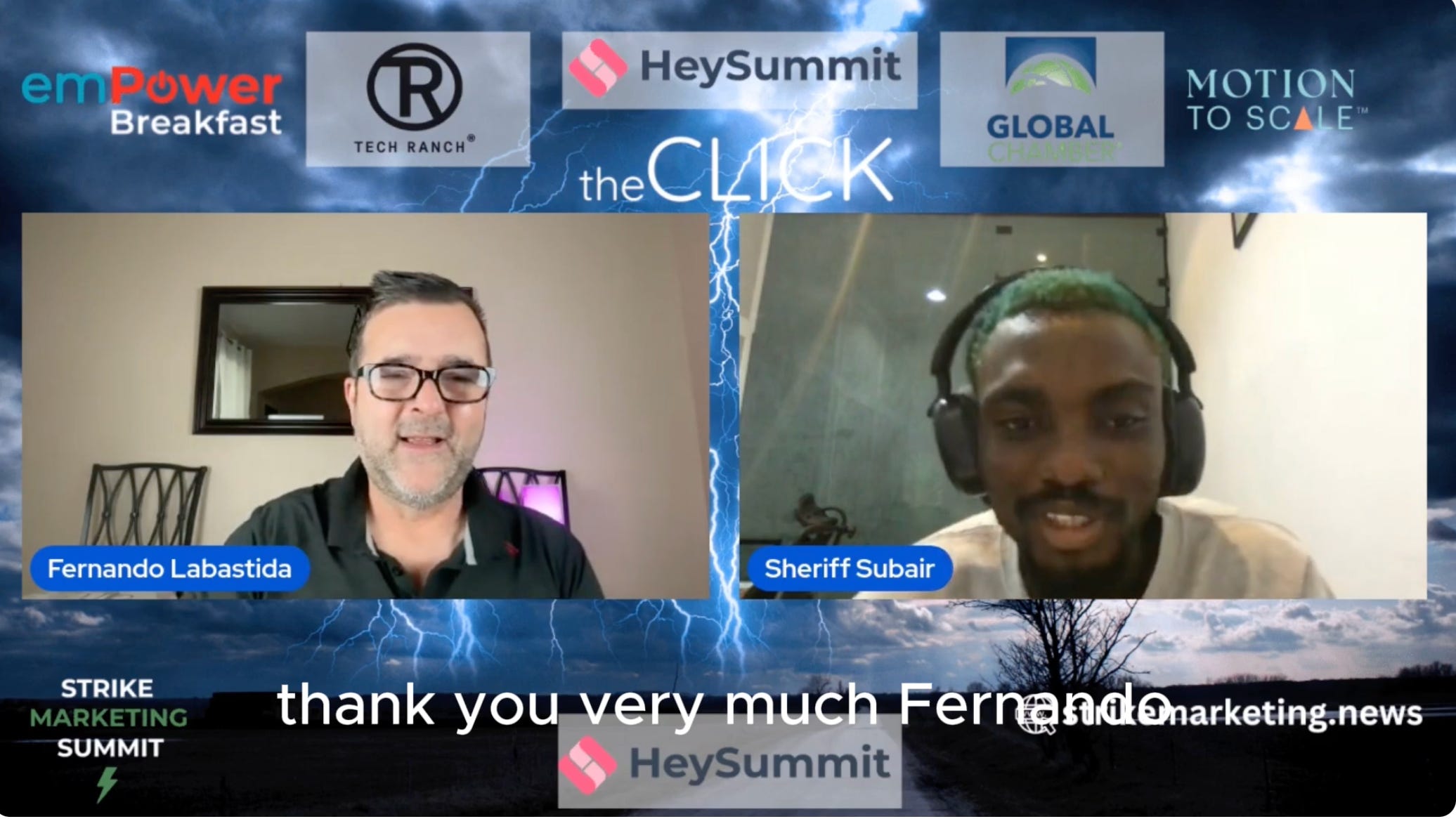
Here’s a screenshot of one of the sessions of my Strike Marketing Summit. Most of the logos on there were promotional sponsors that emailed their subscribers in exchange to being listed a a sponsor.
4. WhatsApp groups, slack groups, or other groups are good as well.
When I was promoting the AI Smart Summit, not only did CANACINTRA supplement their email promotion with WhatsApp group promotion, but one of my speakers promoted the summit to about 6 or 7 groups he manages.
WhatsApp groups, Slack groups, and other kinds of groups share similar characteristics to email newsletters:
The participants chose to be there
They trust the recommendations of the moderators.
So am I saying, “Don’t post your event on social media?” Not at all, go ahead and do it.
The secret I didn’t mention earlier, is that when everybody - your speakers, your team, and other promotional partners - share about your event on social media, you create this cascading effect that makes it look like you’re everywhere.
And you never know who might show up because of some popular person sharing on their Facebook account.
That was the case with one of our speakers at the YouXAI Summit. A popular Baylor Professor shared about our event twice, and she drive quite a few sign-ups.
Granted, her students idolize her, and she’s also a popular speaker at local events. Not all of us have her level of influencer with our followers.
And a funny story: I was promoting videos and posts from interviews I did with the speakers of the AI Smart Summit.
This is another promotional secret: interview your speakers before the event, and use the video and transcript as a “teaser” to potential event participants to excite them about the conference or summit.
I was promoting interview videos from my client’s LinkedIn profile as a ghost-writer, when suddenly an old middle school friend of my client came out of the woodwork, saw all the hoopla about the event, and then offered to promote the event to his 2500 subscribers.
So social media could even lead you to email promotions!
So the bottom line: use everything at your disposal to promote your event, but don’t rely on social media.
Partner with a newsletter operator or an industry association, like a chamber of commerce.
And make sure the owner/operator of the newsletter gets actively involved in the copywriting of the event.
Tell me about your experience promoting your event! How did you do it, what was your best tactic and channel!
See you next week!
Best,
Fernando A. Labastida
Tel/WhatsApp: +1 (512) 945-9273
Inge took nothing form social when I share an event. It's terrible.
Way better to do a big lead magnet blitz beforehand then get them to sign up via email or one to one outreach!
Rather than spending money on promoting an event get a killer lead magnet, sponsor that, promote the hell outta that then with all that new email energy offer the event at the backside of that campaign.